

Pickup Steps for Flat-Track Families: Look at the Rear Door
The motorcycle may travel in the bed or a trailer, but the young rider travels in the cab. For a flat-track family using a pickup, that makes the rear passenger door worth examining before buying running boards. A generous step below the driver's door tells you little about the doorway the child will actually use.
Start with the passenger's seat. NHTSA's child passenger guidance recommends choosing a restraint for the child's age and size, checking that it fits the vehicle, and following both sets of manufacturer instructions. It also recommends keeping children in the back seat through age 12. A running board cannot resolve an unsuitable seating arrangement.
A powered step adds another question: when is it available? Ford's deployment and stowing instructions describe a system affected by approach detection, doors and locking. That example is not a specification for every pickup. Read the instructions for the actual truck and fitted equipment, rather than assuming that every automatic board behaves alike.
The useful part of the board is beside the passenger
With the truck stationary at home, open the rear door and look at the route into the seat. Where is the usable tread relative to the opening? Does the photographed step belong to this cab version? Can an adult reach the seating area without having to work around an unrelated accessory? These are questions to settle before a practice morning.
Use Best Running Boards to explore the available running-board types, then take the exact year, model and cab configuration to the product manufacturer's fitment information. A listing photograph can introduce an option; its installation drawing and application details must establish what is supplied for your truck. For this family use, a clear rear-door view is more informative than another front three-quarter photograph.
Length alone is an incomplete answer. Look for the treaded area below the rear opening, not simply a long bar extending along the body. If the seller cannot show that relationship for the correct cab, leave the fitment question open.
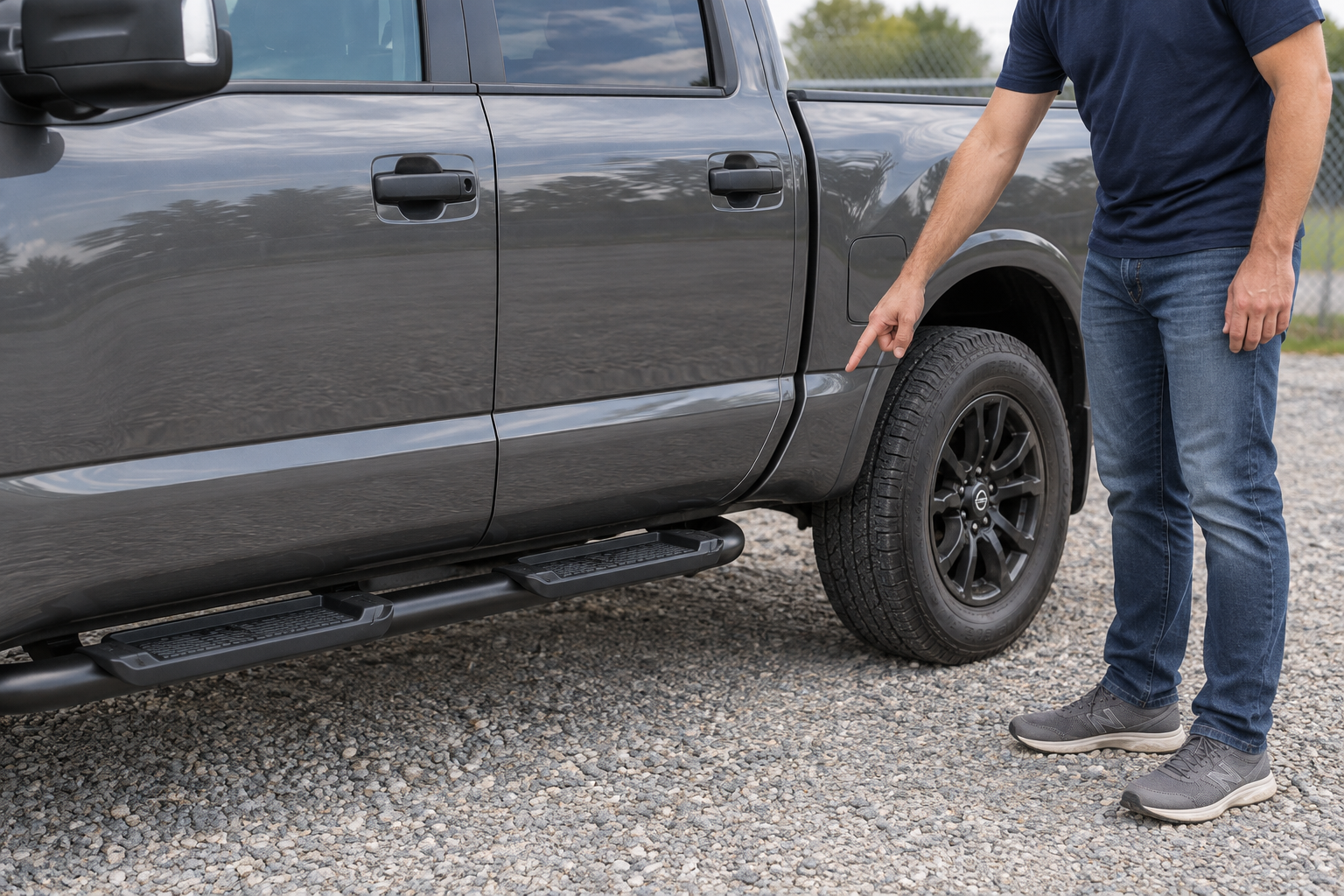
The adult's access matters as well. Someone may need to assist with the child's restraint in accordance with its instructions. Consider that task from the rear doorway; do not choose or move a child's seating position merely to match an accessory.
Try the family arrangement before changing the truck
Use the pickup's present arrangement to identify the actual difficulty. It might be the climb, the space at the open door, or bags left where the passenger needs to move. An accessory addresses only some of those problems. Moving equipment to its proper storage place may answer the question before any purchase.
For a powered board, have the supplier demonstrate the relevant door sequence and explain the settings using the correct instructions. For a fixed board, ask to see its position under the rear opening on the matching cab. Neither demonstration establishes that a particular child can use it independently.
Keep practice preparation in its own place. The site's paddock safety loop already explains why riding equipment and work areas need clear boundaries. The rear-seat doorway should remain a way into the vehicle, rather than becoming another place to pile helmets and tools.
The decision is specific: does this setup suit the passenger's existing travel arrangement, at the door the family actually uses? If the answer depends on a different cab photograph or an unexplained mechanism, ask for the missing detail. Buying can wait until the rear-door view makes sense.