

Youth Rider Development
How to Watch One Corner and Give a Young Flat-Track Rider Useful Feedback
The most useful note from a practice session is rarely “go faster.” It is a small, repeatable observation from one place on the track—something the rider can recognize, describe and test on the next lap.
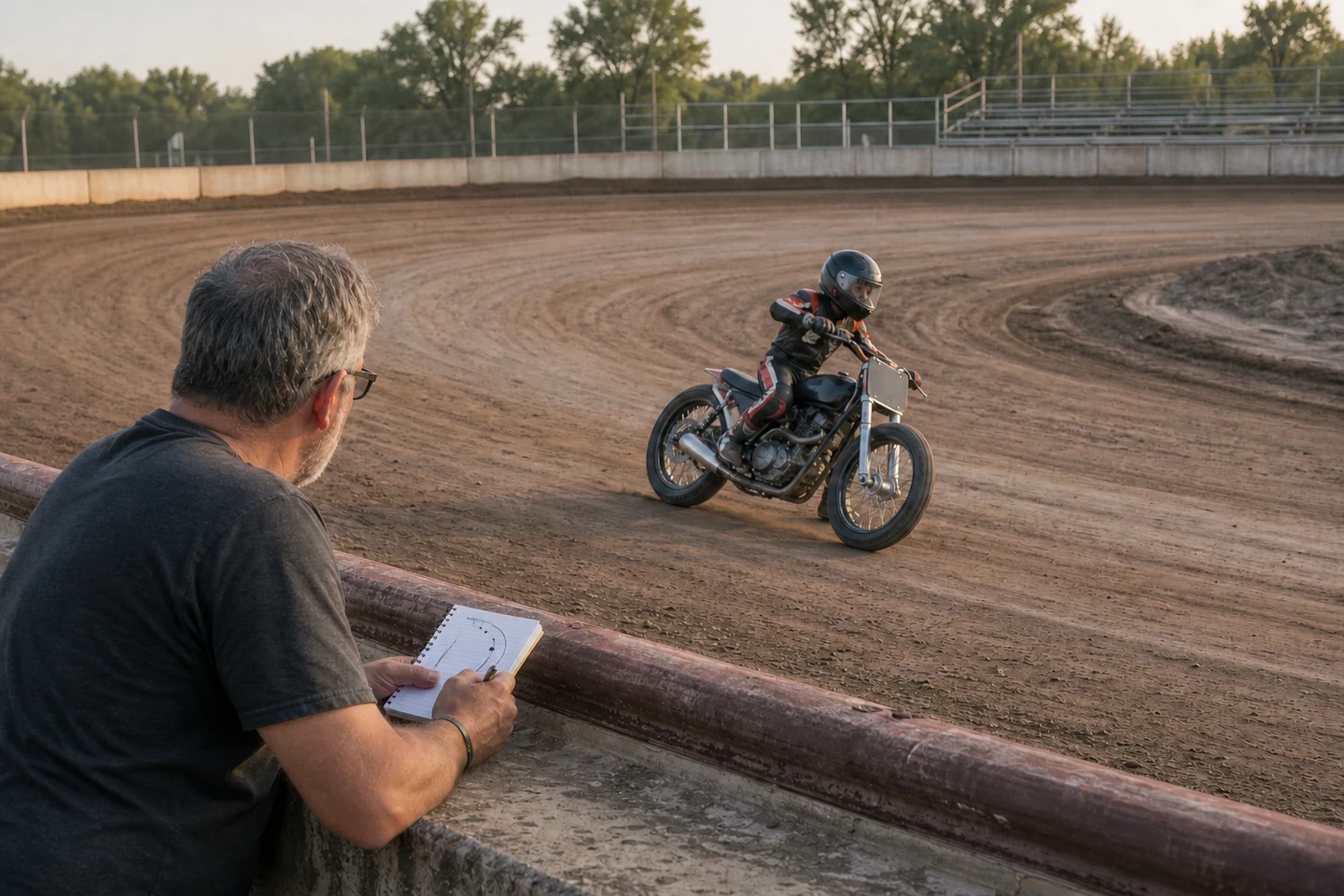
Watching one corner well is harder than watching the whole session casually. The engine note, dust and speed invite quick conclusions. A parent or helper can be more useful by narrowing the task: choose one safe viewing position, watch the same entry and exit several times, and write only what can actually be seen or heard.
Set the boundary before you take notes
Observation does not replace coaching, officiating or mechanical judgment. The current organizer instructions come first, and the American Motorcyclist Association's racing rulebook resource explains that common competition rules can be supplemented by event-specific regulations. The person with the notebook stays behind the designated barrier, follows officials' directions and never tries to signal a rider from an unsafe place.
Agree on the subject of the observation before the motorcycle rolls. It might be whether the rider uses the same entry area on three laps, whether the motorcycle looks settled through the middle, or whether the exit opens toward the same part of the straight. Pick one question. If you watch everything, the notes usually become a list of impressions rather than evidence.
Keep the viewing position fixed for the whole comparison. Moving several yards along the fence can make the same line look earlier, later, tighter or wider. If officials require spectators to relocate, start a fresh set of notes instead of comparing the new angle with the old one.
Use the first two laps to look, not to diagnose
On the first pass, keep the pen still. Find the rider, locate the chosen corner and notice what the sightline hides. On the second pass, watch the same sequence again. Only then write a short neutral description: “entered near the dark groove,” “stood the motorcycle up before the exit,” or “engine note changed halfway across the corner.”
A neutral note says what happened without pretending to know why. “The front moved twice” is an observation. “The front moved because the rider was afraid” is a guess. If the view is blocked by dust, another motorcycle or the barrier, write “not visible” and wait for a cleaner lap.
Read entry, middle and exit as one sequence
Divide the corner into three moments, but do not treat them as separate tricks. At entry, note the reference point and whether the rider arrives with room to make the turn. In the middle, notice the motorcycle's direction and whether the rider appears to be correcting the line repeatedly. At exit, watch where the bike is pointed and how much track remains before the boundary.
Track shape and surface change what a rider needs. American Flat Track's event-specific Lima Half-Mile viewing guide, for example, discusses the character of that particular circuit rather than offering one universal line for every venue. That is the right model for a practice notebook: describe this corner, on this surface, during this session.
Compare the rider with the rider
Do not turn the notebook into a ranking of young riders. Compare three clean laps from the same rider. Circle the detail that repeated, then mark the detail that changed. A repeated entry with two different exits is more informative than a single dramatic lap. So is the absence of a pattern: if every pass is different, the next question may be about finding a reference point rather than changing speed.
A simple mark beside each lap is enough. Use a dot when the chosen reference repeats, a dash when the moment is hidden, and one short phrase when something changes. Long sentences encourage the observer to miss the next pass. They also make a small difference sound more important than it was.
American Flat Track's AFT 101 overview shows how varied the discipline is across short tracks, half-miles, miles and TT courses. Even at a local practice, that variety is a reminder not to copy a television image into a different corner. The useful comparison is the rider's own repeatability under today's conditions.
Ask one question after the session
Wait until the rider is off the motorcycle, settled and ready to talk. Start with one observation and one question: “I saw the exit move wider on the last two laps. What did that part of the corner feel like?” The rider may have information the observer cannot see—a bump, changing grip, traffic ahead or an instruction from the coach.
Listen before offering an explanation. If a qualified coach is present, hand over the short note rather than competing with the coaching plan. The note can support a conversation; it should not become a second set of trackside commands.
If the rider's description and the notebook do not match, keep both accounts. The observer may have missed the cause, and the rider may have felt something that was invisible from the fence. A useful follow-up is not “which account is right?” but “what could we watch on the next clean lap to learn more?”
Stop when the evidence stops
Dust, a poor angle or only one visible lap can make a notebook look more certain than it is. Say what was not seen. Leave space for the rider's account. If there is a safety, medical or mechanical concern, stop analyzing performance and bring it to the responsible adult, official or qualified professional.
A useful corner note is modest: one location, several comparable laps, one clear observation and one question. That is enough to help a young rider think about the session without turning a parent or helper into an improvised crew chief.